By Joe Aylott, Multi-Asset Strategist

  • Our research reveals growing opportunities in emerging market (EM) equities, driven by better earnings prospects and a weaker US dollar.
  • Exposure to technology and the artificial intelligence (AI) theme in EM equity markets is almost as high as in the US, and much higher than in markets such as Europe.
  • Interest rate cuts led by the US Federal Reserve (Fed) could serve as a tailwind for global equities and act as a catalyst for broadening market performance.

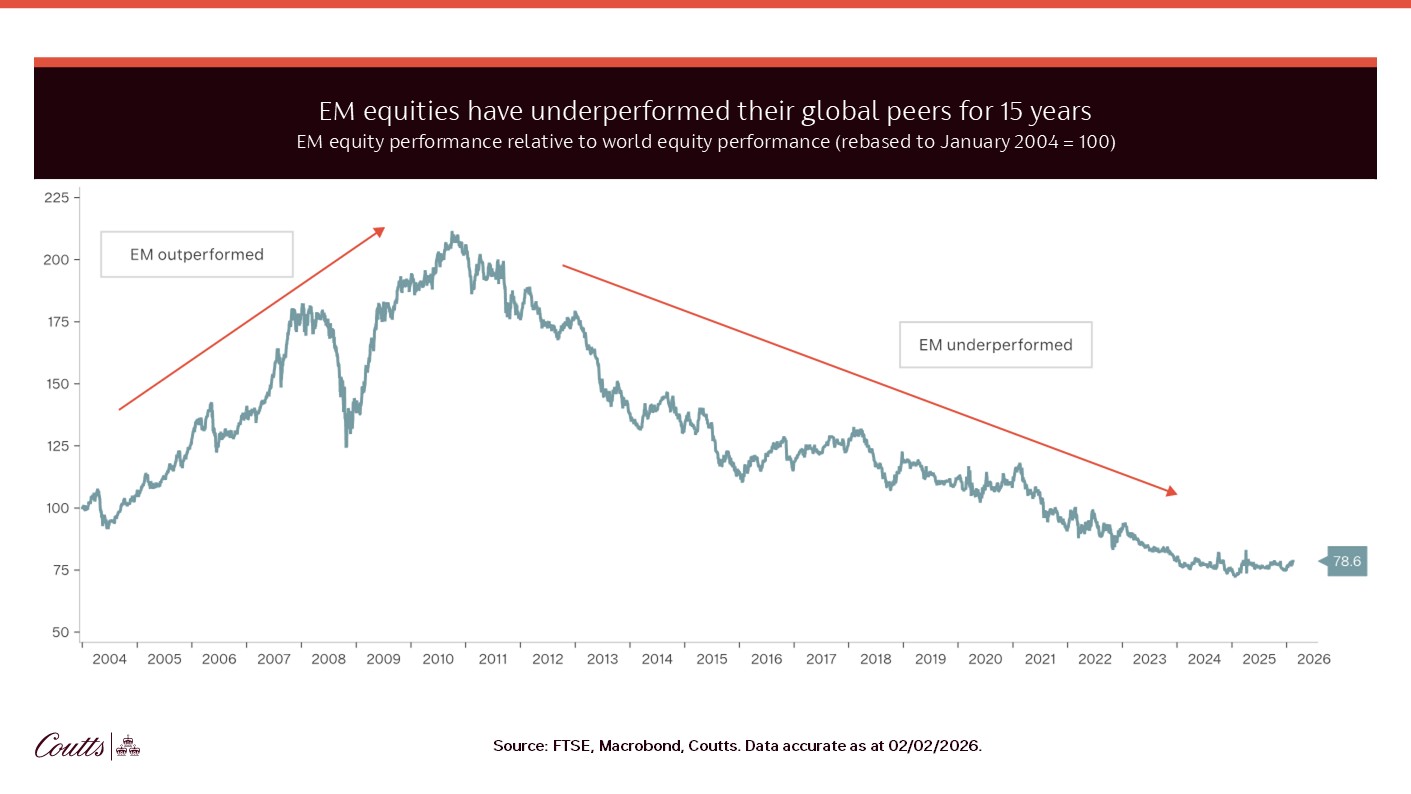
For large parts of the last 15 years, EM equities have underperformed their developed market (DM) peers. However, our regional analysis suggests we could be reaching a critical inflection point. Our research reveals growing opportunities in EM equities, driven by better earnings prospects.

Consequently, we have recently adjusted our equity positioning to reflect a preference for equities from EM economies.

Historically, EM equities have experienced sustained periods of outperformance and underperformance. For example, between 2004 and 2010, EM equities delivered approximately twice the performance of their DM counterparts, before these relative gains were subsequently erased in the following 15 years.

However, in 2025, EM equity markets began to regain their footing. Equity markets in Taiwan, South Korea, China, and Latin America delivered solid returns, and although India underperformed, a recent trade deal with the US removes a significant headwind to growth. In 2025, around half of the returns came from increased valuations, whilst half came from earnings upgrades.

As we look ahead to 2026, we expect earnings growth to do the heavy lifting.

The value of investments, and the income from them, can fall as well as rise and you may not get back what you put in. You should continue to hold cash for your short-term needs. Past performance should not be taken as a guide to future performance. This article should not be taken as advice.

There are two core reasons why we believe EM economies could deliver faster earnings growth than their DM peers. 

AI as a driving force for earnings

Although the AI trade has become more volatile recently, we believe it could continue to be a key driver for global equities.

Firstly, around one-third of the EM equity universe is in technology, or technology-adjacent, sectors. Proportionally, this makes the level of technology exposure in EM equity markets almost as high as in the US equity market, and much higher than in non-US developed equity markets such as Europe.

These elevated levels of technology exposure in EM equity markets represent an evolution in the role of EM within the global supply chain. When the last period of sustained emerging market performance came to an end (in 2010), the largest EM equities provided investors with exposure to traditional industrials and commodity firms. Today, however, many emerging markets have become world-leading in technology sub-sectors, including semiconductors, payments, and renewable energy.

This shift has allowed industrial production and exports in emerging markets to grow faster than those of developed market peers. We anticipate this continuing.

Taiwan, South Korea, and China are crucial components of the global technology supply chain and should benefit as demand for AI continues to expand, driven by improvements in model performance and widening productivity implications. We anticipate this trend to accelerate in 2026, which should further support AI demand. If this occurs, it could help maintain a robust export market for the semiconductors essential to AI, thereby supporting the earnings outlook for chip producers in South Korea and Taiwan in particular.

Although it can be difficult to identify in aggregate economic data, recent company earnings have begun to report anecdotal evidence of the productivity-enhancing impact of AI. This is evident across a broad range of sectors and includes, for example, the use of AI to reduce bottlenecks in retail supply chains, as well as financial firms employing AI tools to detect fraud and improve customer service applications.

Our analysis also indicates that the positive feedback loop between investment and growth in AI still has further to run. More broadly, we believe that continued capital expenditure in this area has the potential to drive corporate earnings higher worldwide in 2026.


An extra boost from global growth

The second core reason we see increasing potential in EM equities relates to our latest analysis of the global economy. Our proprietary model has recently indicated a shift from ‘slowdown’ to ‘expansion’ – signalling that global economic growth is accelerating.

EM equities tend to do well (on a relative basis) during times of expansion and recovery, due to their significant exposure to global manufacturing and industrial cycles. Consequentially, given our positive outlook for the global economy, we see a growing opportunity for EM equities. This environment could further contribute to a boost in corporate earnings across EM.

In addition to the two core reasons, several other factors may also support the performance of EM equities.

Interest rate cuts could act as a further tailwind

The Fed is currently undertaking an interest rate-cutting cycle, which could serve as a tailwind for global equities and act as a catalyst for a broadening of market performance. In a so-called ‘soft landing’ scenario — where rate cuts occur without an accompanying recession — EM equities have historically performed well. 

A weaker US dollar could help bolster EM equities

Historically, weakness in the US dollar has also been helpful for equities from the region, and our currency analysis framework continues to suggest the dollar is currently expensive.

Many EM countries and businesses issue their debt in US dollars, meaning that debt-servicing costs fall when the dollar is weaker. A weaker dollar also allows greater domestic monetary policy flexibility within EM.

We do not think the potential for EM outperformance ahead is predicated on dollar weakness. However, it could help performance at the margin.

Starting from a position of good value on the world stage

Equity price valuations in EM are currently near record lows relative to global peers. While we expect earnings to be the dominant driver of returns in emerging markets this year, the undemanding starting valuations help increase our conviction that EM equities could outperform.

Solid fundamentals point to continued growth

EM equities are expected to deliver the strongest earnings per share (EPS) growth of major regions in 2026, led by South Korea and followed by South Africa and Taiwan.

There are, of course, potential challenges. Weaker corporate governance in EM relative to DM has been a headwind over the last decade. While there are signs of improvement, this remains an area to monitor closely.

Furthermore, although a weaker US dollar is not central to our positive outlook on EM equities, a significant rally in the dollar could impede their performance. Similarly, we remain mindful of the potential impact of tightening financial conditions or an unexpected US recession.

Overall, however, when considering their robust track record during periods of economic expansion, EM equities’ central role in the growth of AI, and the marginal support from a weaker dollar, we believe EM equities are well positioned to perform strongly this year.

scroll to top