Investing

CIO Mid-year Investment Outlook 2026

Past performance should not be taken as a guide to future performance. The value of investments, and the income from them, can fall as well as rise and you may not get back what you put in. You should continue to hold cash for your short-term needs. This publication should not be taken as advice.

Introduction

Building plans to withstand the unexpected

‘No plan survives first contact with the enemy’, as the military adage goes. But in investing, the objective isn’t to avoid disruption – it’s to plan for it.

The first half of the year provided a real-world stress test for investors’ best laid plans. As tensions escalated in the Middle East, many expected markets to falter. Instead, characteristically forward-looking equities proved more resilient than anticipated. Periods of turbulence aside, investors focused less on geopolitics and more on robust corporate earnings, especially relating to artificial intelligence (AI) – a theme explored in Chapter 1 by our Senior US Equity Specialist, Howard Sparks.

Source: S&P Global, Macrobond, Coutts. Data accurate as at 09/06/2026.

For those who held their nerve and stayed invested, there was an opportunity for reward. Guided by our disciplined, data-led process, we maintained an overweight to equities, where we continued to see more compelling value than in bonds.

That said, discipline is not rigidity. Shortly before publishing this Outlook, we modestly reduced our risk levels. Risk is an essential part of investing, and it’s not something we seek to avoid, but something we aim to take deliberately. We’re still overweight equities, but less so.

This adjustment is not a reaction to geopolitical developments; rather, it reflects an evolving policy backdrop where monetary conditions are likely to get tighter. We follow our plan, but we also respond to material information. Chapter 2, from our Head of Asset Allocation Lilian Chovin, sets out our framework and current positioning in more detail.

Our key investment views:

  • We are overweight equities versus government bonds, though we reduced the extent of this overweight in June, responding to the outlook for monetary policy.
  • Within our global equity exposure, we are underweight US and European equities and prefer emerging market equities, where we see more attractive access to growth themes like AI.
  • Where appropriate for client portfolios, we favour diversification through gold and liquid alternatives.

As multi-asset investors, diversification remains a core line of defence. Different asset classes respond differently under pressure and maintaining that breadth allows us to navigate uncertainty with greater resilience. In Chapter 3, Multi-Asset Strategist Joe Aylott outlines the role our deep bench of diversifying assets plays in our approach.

Within that framework, we are also finding renewed opportunities in selective areas of fixed income. In Chapter 4, James Hawkes, Head of Direct Securities, and Mallika Khoobarry, Multi-Asset Portfolio Manager, explain why bonds are once again asserting their role in multi-asset portfolios.

Planning, however, is only as robust as the testing behind it. In Chapter 5, our Head of Portfolio Analytics, Mathilde Helaine, demonstrates how we examine resilience in practice, unpicking how portfolio diversifiers behave during periods of extreme equity market stress.

Not every plan survives first contact. But we believe those built on discipline, diversification and a willingness to respond to the right signals – rather than the loudest noise – are more likely to hold their ground and deliver for investors when it matters most.

Chapter 1

Can AI sustain equity market earnings?

By Howard Sparks, Senior US Equity Specialist

A pro-risk mood among investors, supported by strong corporate earnings, has driven global equities higher in the first half of 2026.

US-listed companies have reported average earnings growth of around 27% year-on-year over the first three months of the year. This was more than double the 12% growth predicted before results were announced.

Investor expectations for AI are rising further

In the first quarter of the year, technology companies delivered earnings growth in excess of 50%, compared to roughly 20% for the broader market (excluding the technology sector).

This dispersion is already significant, but investors anticipate that technology will pull even further ahead: expected technology earnings growth is accelerating towards 60% for Q2 this year, while growth for non-technology companies is expected to slow to around 10% – still solid growth despite being much lower than tech.

Source: Bloomberg, Macrobond, Coutts. Data accurate as at 10/06/2026. Actual data up to Q1 2026, expectations thereafter.

This momentum reflects a rapid expansion in AI infrastructure, with hyperscalers now expected to spend more than $650 billion in 2026 alone. Such sustained investment supports multi-year economic activity and has broader market impacts.

Emerging market (EM) equities have also ridden the wave of AI‑driven momentum, reflecting their integral position in the semiconductor supply chain. Technology‑heavy EM indices have climbed to fresh highs, with South Korea’s Kospi, for example, up more than 100% so far in 2026 at the time of writing. This reinforces the rationale behind our decision to increase exposure to EM equities at the beginning of this year, reflecting our view of EM as a more diversified way to access the AI theme through a broader range of countries, sectors, and companies.

AI is supporting earnings, but risks are in focus

AI leadership in equity markets brings opportunities and has bolstered corporate earnings, but we’re mindful of three risks too.

  • The first risk is specific to equity markets: a growing dependence on the AI theme. Using EM equities as an example, a small group of leading semiconductor companies has been driving a disproportionate share of returns, accounting for 62% of market performance so far in 2026 and 58% of earnings growth in Q1. While this underlines the strength of the AI theme, it also points to increased concentration, leaving EM equities more exposed to any slowdown in AI‑related investment.
  • The second risk is more exogenous in nature: the potential for higher energy prices arising from the US-Iran conflict to feed through into inflation. So far, these pressures have yet to be reflected in corporate earnings, but the impact is unlikely to be evenly distributed geographically. EM countries are often seen as sensitive to energy costs, but Europe imports around 60% of its energy.
  • The third risk relates more directly to consumers: in the US, consumers are a powerful economic force, and overall US consumer spending has shown solid growth since 2023. However, headline strength can mask reliance on a relatively small group. Recent data on spending patterns suggest that higher income households (earning above $125,000) have been the main drivers of retail growth, leading to what is often described as a ‘K‑shaped’ economy, where wealthier households pull ahead while others lag behind. We’re mindful of the combined impact on corporate earnings of strained household finances alongside potentially inflationary energy prices.

The way ahead: a constructive outlook for earnings in 2026

We assess these risks as contained for now, with investors still being rewarded for exposure to the AI theme. The pace of investment in AI shows little sign of slowing, underpinning a strong earnings backdrop. We also remain attentive to potential inflationary pressures – particularly from energy – using our Anchor & Cycle framework to monitor developments closely.

Taken together, the outlook for earnings reinforces our pro‑risk stance. While we have made some modest adjustments to our equity exposure in response to evolving policy signals, the overall environment remains supportive. In particular, we maintain a constructive view on equities, with a continued preference for EM.

Chapter 2

Staying disciplined in uncertain markets

By Lilian Chovin, Head of Asset Allocation

Geopolitical tensions in the Middle East have disrupted shipping routes and energy markets, adding uncertainty to the inflation and growth outlook. These developments matter, and we monitor them closely. But our investment process is designed to distinguish between short-term market shocks and more persistent changes in the economic cycle.

At this stage, the evidence does not suggest that the broader investment backdrop has fundamentally changed, though it warrants closer monitoring. The global economy entered this period from a position of relative strength. Growth remains steady and corporate earnings continue to rise. As a result, we continue to favour equities over bonds across our portfolios and funds.

A constructive backdrop, despite higher uncertainty

A major reason why the Middle East conflict has not derailed the investment outlook is sustained investment in AI. Capital expenditure — estimated at more than $650 billion this year for the largest US hyperscalers — has become a key driver of corporate revenues, earnings, and productivity expectations. 

Source: Bloomberg, Macrobond, Coutts. Data accurate as at 15/06/2026.

This investment is not confined to one company or sector. It spans data centres, semiconductors, cloud infrastructure, power demand, and software applications.

This has created a bifurcated market environment. On one side, geopolitical risks and oil market disruption have increased uncertainty. On the other, the AI and technology investment cycle continues to support earnings and equity performance.

So far, the positive earnings impulse has outweighed the negative macro shock. While markets are likely to remain sensitive to headlines, we believe steady growth, resilient earnings, and manageable inflation continue to favour equities over bonds.

That said, the recent tightening in financial conditions, captured by our proprietary policy impact indicator, suggests markets are increasingly pricing in higher rates for longer. This has led us to adopt a slightly more cautious stance, even as we continue to favour a constructive position on equities.

Emerging markets: an evolving opportunity

Within equities, we continue to favour EM. This reflects a combination of more attractive valuations, improving earnings prospects and exposure to long-term structural growth themes, particularly AI.

The US technology story is well understood. But Asia’s role in the global AI supply chain remains underappreciated. South Korea, Taiwan, and China account for a significant share of the emerging market equity universe and sit at the centre of global semiconductor production, hardware manufacturing, and technology infrastructure.

Historically, EM performance was often closely tied to commodity cycles, domestic politics, and global liquidity. But earnings growth is increasingly driven by global investment cycles, technology demand, and supply chain leadership. Within technology, for example, semiconductor companies now make up a quarter of emerging market equities by weight.

This shift broadens the case for EM equities beyond simply being a valuation opportunity. 

Source: Bloomberg, Macrobond, Coutts. Data accurate as at 31/03/2026.

Interpreting market and economic signals 

A key principle of our investment approach is the dual-engine design of our Anchor & Cycle process. Anchor focuses on long-term valuation and structural drivers, while Cycle provides tactical responsiveness to more immediate changes in growth, inflation, and policy.

Our Cycle indicators continue to support a stance that favours equities, albeit with more moderate conviction than earlier in the year. However, our Anchor analysis highlights elevated equity valuations and low dispersion in fixed income as areas of potential vulnerability.

This informs our approach to diversification, which involves adopting a suite of assets to help cushion portfolios and funds from various risks, rather than relying on a single asset class. We maintain exposure to bonds – which play a key role as an income provider and recession hedge. But we also include, in certain funds and portfolios, gold, currency hedging, and ‘liquid alternatives’ (strategies which adopt a broader range of techniques than traditional financial assets, such as short-selling, which aims to benefit when an asset's price drops).

What could change our view?

While we currently favour an overweight position in equities, we have already adjusted the magnitude of this stance in response to tightening financial conditions. We believe additional caution would be warranted in the event of:

  • a material slowdown in AI-driven capital expenditure by large US hyperscalers
  • a sustained reacceleration in inflation
  • the US Federal Reserve (Fed) adopting a more aggressive monetary policy – increasing interest rates and keeping them high.

Notably, an energy shock is not central to this list. We view such disruptions as temporary and largely absorbable, given contained wage pressures and resilient consumer demand.

In short, while the Middle East conflict has certainly increased uncertainty, it has not altered the broader investment outlook.

We continue to keep a close eye on developments, adopting a disciplined, diversified approach that remains responsive to evolving risks. But in our view, steady growth and resilient earnings should continue to support equity markets over the rest of this year and beyond.

Chapter 3

Why investors need a deep bench of diversifiers

By Joe Aylott, Multi-Asset Strategist

Higher inflation volatility, a more fragmented geopolitical backdrop, and elevated government debt all mean that multi-asset investors must consider a wider range of potential risks today than at various times during the last two decades.

Against this global backdrop, while government bonds continue to have an important role to play in our portfolios and funds, they have not protected them consistently during recent equity drawdowns. However, we also have a deep bench of other diversifiers to draw upon.

Source: Macrobond, Coutts. Data accurate as at 10/06/2026.

Different diversifiers shine in different conditions

Each market-moving event has different causes, and idiosyncratic factors that influence investor behaviour.

The perfect diversifier would show consistent positive, uncorrelated returns over time, have high sensitivity to volatile markets, and perform particularly well during market drawdowns.

Unfortunately, the perfect diversifier does not exist. Instead, we construct a suite of diversifiers that explicitly targets and considers each of these three characteristics. When done well, diversification can help us to build portfolios and funds capable of dealing with unforeseen risks.

Our investment approach currently includes bonds and (in certain portfolios) liquid alternatives, gold, and targeted currency diversification.

Gold is the most recent addition to our alternatives basket. The gold market is small relative to global bond and equity markets, and so an increase in demand from a particular investor type can cause a meaningful shift in supply/demand dynamics. In recent years, this demand shift has come from central banks.

US dollar-denominated reserves, adjusted for valuation effects, are now lower than gold reserves in the global central banking system for the first time since the International Monetary Fund started publishing this data in the late 1990s, according to Bloomberg. Given these fundamentals, we continue to think that, in the current environment, an allocation to gold as part of a broader diversifying portfolio is warranted.

Taking a long-term approach

Predicting the performance of diversifiers in the short term can be difficult. For example, in the first month of equity market corrections over the last 20 years, gold has experienced positive returns 50% of the time. However, if we extend the timeframe to look at the 12 months following the start of the correction, gold has experienced positive returns 90% of the time.

The reason for this is likely because, early in a market correction, gold prices can come under pressure as investors seek to raise cash. This can require the selling of positions that have previously been resilient, including gold. Overreacting to, and judging, diversifiers based on short-term moves could lead to suboptimal decision-making, and less robust portfolios over time.

Protecting the downside

We do not wait until volatility hits before we worry about diversification: the decisions we make during times of market stability are exactly what can protect us during market turmoil. In January of this year, our positioning was more diversified than it had been for some time, with positions across G7 government bonds, diversified currencies, plus gold and liquid alternatives where appropriate for our clients. This stood portfolios and funds in good stead during volatility triggered by escalations in the Middle East.

Aiming to ‘protect on the downside’ is fundamental to our investment philosophy. In our view, downside protection does not depend on perfectly forecasting the next recession, oil shock, or fiscal event. Instead, our approach is centred on building portfolios and funds that are sufficiently robust to withstand a wide range of scenarios as they emerge. In the first half of the year, this at times required a broader and more flexible approach to diversification. We expect this technique to stand us in good stead in the second half of 2026.

Diversifiers now play a vital role in protecting against equity drawdowns and managing risk in multi-asset portfolios, as Mathilde Helaine demonstrates later in this Outlook. And in such a fast-paced global market, we need a wide range of different diversifiers.

As we enter the second half of 2026, bonds continue to have an important role to play alongside equities in our portfolios. However, our approach to diversification reduces our reliance on one diversifier and seeks to ensure our portfolios can remain resilient to a range of outcomes, including both those we can foresee and those we cannot.


Chapter 4

Bonds are reasserting their role

By James Hawkes, Head of Direct Securities, and Mallika Khoobarry, Fixed Income Specialist

Bond markets have undergone a meaningful reset. After a decade of ultra-low yields, bonds now offer improved income, positive real returns, and a diverse range of options. At the same time, a more complex economic backdrop has challenged traditional assumptions around diversification.

Government bonds: diversifying risk, but not in all circumstances

Government bonds remain central to our multi-asset portfolios, particularly for their role as a diversifier. In demand-led slowdowns, where growth weakens and inflation declines, central banks typically ease policy. This has historically driven bond yields lower and bond prices higher, delivering both income and capital gains when risk assets tend to struggle.

However, we don’t expect bonds to hedge against all risks. In supply-driven or inflationary shocks, bonds can fail to provide protection. Recent tensions in the Middle East illustrate this dynamic. Rather than rallying as a defensive asset, in the first half of 2026 government bonds have at times sold off due to concerns that higher energy prices could sustain inflation.

Today’s environment remains one of economic resilience, supporting our overall preference for equities. However, the lagged effects of tighter central bank policy still leave open the possibility of a more traditional, demand-led slowdown. In such a scenario, government bonds could be well positioned to perform their defensive role.

Investors require more compensation: the return of real yields

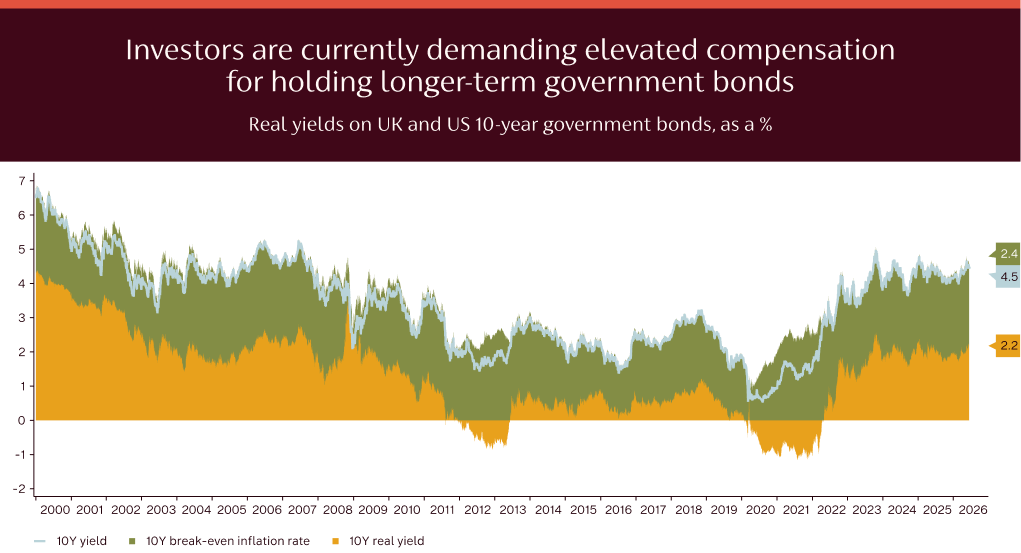
One of the most important developments in fixed income markets is the return of positive real yields (i.e. yields after accounting for the effects of inflation).

Five years ago, government bond yields were near zero, and in many cases negative after inflation. Today, yields are materially higher. This reflects higher government deficits and debt, inflation risks, and reduced central bank intervention, as quantitative easing unwinds. These dynamics have contributed to the recent re-emergence of term premia – the extra compensation investors demand for holding longer-dated bonds – which is contributing to both higher yields and greater volatility.

For investors, this is ultimately constructive. Higher starting yields provide a stronger foundation for returns, positive real yields improve purchasing power over time, and volatility creates potential buying opportunities. It could also restore the dual role of bonds: income generation and capital appreciation potential, particularly in growth slowdowns.

Source: US Department of Treasury, Federal Reserve, Macrobond, Coutts. Data accurate as at 09/06/2026.

Not all bonds are equal: diversification can enhance returns and yield

Diversification within the evolving bond landscape has become increasingly important. Outcomes are now more dependent on geography, sector allocation, and income generation.

Government bond markets are no longer moving in lockstep. Government policies and idiosyncratic political risks, inflation trends, and investor positioning can all drive significant divergence. This reinforces the potential value of maintaining diversified exposure across G7 issuers.

Alongside government bonds, investment grade corporate bonds can play an important complementary role. They offer a yield premium over government bonds while retaining relatively defensive characteristics. Over the long term, this has made corporate bonds a core component of our approach, rather than purely a defensive add-on.

Corporate debt levels are gradually rising, supported by shareholder activity, but this is balanced by still robust company cash flows and earnings. This has historically been a stable backdrop for corporate bond markets. However, valuations remain tight, with spreads (the extra compensation investors require for taking on risks like longer maturity) near the lower end of historical ranges.

So, while investment grade credit can continue to enhance income and diversification, and without materially increasing portfolio volatility, current pricing tempers near-term return expectations as we head into the second half of the year.

Further up the risk spectrum of corporate bond markets, ‘high yield’ bonds offer higher income but introduce greater economic sensitivity. At present, we prefer to express our positive view on the economic growth outlook through equities.

A more nuanced but enduring role for bonds

While equities remain favoured in the current growth environment, bonds continue to play an important role. They provide meaningful income, potential protection in demand-led downturns, and diversified return streams across regions and sectors.

The key is a more selective and balanced approach. Rather than relying on bonds as a universal hedge, portfolios should benefit from their improved income profile, conditional diversification, and broader bond investment choices.

Chapter 5

Beyond assumptions - how to test investment resilience 

By Mathilde Helaine, Head of Portfolio Analytics

Investors aiming to construct a truly robust portfolio must understand how different assets behave in the most challenging conditions.

Lessons from the past

Rather than relying on the assumption that traditional defensive assets will always offer protection, it is essential to examine how different asset types have performed during past periods of stress.

Examples include disinflationary shocks such as the Global Financial Crisis, liquidity-driven selloffs during the Covid-19 crisis, the inflation-led repricing of 2022, and more recent market corrections in March 2025 and March 2026.

In the chart below, we show how three different portfolio diversifiers – G7 government bonds, gold and liquid alternatives – have performed during some of the most challenging months for equity markets in recent decades. These three assets aren’t the only diversification options available, but they offer a useful cross-section of how different diversifiers behave across a range of market scenarios.

Source: Shiller, Macrobond, Coutts. Data accurate as at 09/06/2026.

Each of the periods above represents a different type of shock, and this is clearly reflected in the varying performance of diversifiers.

For example, in the most recent two market stress events – March 2025 and March 2026 – equity markets fell by broadly similar magnitudes over the calendar month. However, the relative effectiveness of diversifiers was very different across these two instances. In the former, bonds and gold performed well; in the latter, liquid alternatives fared much better.

Preparing for the future

Perfect foresight in financial markets is unrealistic, but we can draw on examples from the past to inform simulations of how asset types could behave in the future. This allows us to prepare for a range of possible future outcomes for investment portfolios.

‘Stress testing’ helps us to assess how different asset types might perform in extreme market conditions, such as sharp downturns or sudden shocks. Our process involves simulating a range of adverse scenarios, from equity market crashes to interest rate spikes, using robust models and historical data. These simulations allow us to quantify potential losses and identify key vulnerabilities in different portfolio constructions.

In keeping with the historical examples, such as the ones shown above, our stress testing reinforces that outcomes for different diversifiers depend heavily on the underlying economic and market environment. For instance:

  • government bonds have provided meaningful downside protection in low growth environments; in others, rising inflation expectations have reduced their defensive characteristics
  • liquid alternatives have generally offered lower-volatility ballast, albeit with variability in outcomes and cost considerations
  • gold is often viewed as a ‘safe haven’ and can act as an effective hedge, though performance may be mixed in the early stages of market deleveraging.

Incorporating these differentiated behaviours into our risk management framework allows us to assess a distribution of potential portfolio outcomes, rather than relying on a single set of assumptions.

Managing risk, not avoiding it

We know that we can’t avoid all risk, and we wouldn’t want to: risk is an important feature of investing and presents opportunities as well as challenges.

However, analysis and stress testing can help us to mitigate some of the surprises that market shocks bring, by improving our understanding of how portfolios may behave under strain. They also form part of our broader risk framework, helping us manage downside risk, align investments with client risk profiles, and support disciplined decision-making across our investment process. Results are reviewed regularly, ensuring that investment portfolios stay aligned with their objectives even in challenging markets.

This approach enables a more robust assessment of the trade-off between expected returns and portfolio resilience, while continuously refining the mix of diversifying exposures within portfolios.

In our view, preparedness and resilience are not about predicting the precise nature of the next market shock. Instead, they are about constructing portfolios that can weather a broad range of scenarios, embedding flexibility and robustness at the core of portfolio design.

Conclusion

Holding the line - positioning with purpose

By Fahad Kamal, Chief Investment Officer

The chapters in this Outlook set out the rationale behind our positioning: a disciplined process, tested under pressure, and refined as the signals evolve. We believe that this combination – preparation, diversification, and measured adjustment – give our plans their best chance of delivering in a range of market conditions over time.

As we head into the second half of the year, the geopolitical calendar will continue to demand attention. Let’s start with the likely media headlines as the calendar pages keep turning. The main event will be the US mid-term elections in November, when the majority of Congressional seats will be contested. These elections will undoubtedly focus policymakers’ minds, with the potential for a more assertive policy stance from Washington thereafter to off-set any possible concerns about reduced political leverage within the administration.

Before that, in September, China’s President Xi Jinping is visiting Washington – a trip that may provide important signals on international trade. More broadly, the global race for technological relevance continues to gather pace, driving both cooperation and competition between major economies.

Grounded in fundamentals

Against that backdrop, our investment views remain grounded in fundamentals. We expect robust earnings to continue through the second half of the year, though we’re mindful of elevated investor expectations. We’re also keeping a watchful eye on the potential impact of policy change, particularly to the degree financial conditions tighten. We continue to favour equities over bonds, albeit with some recalibration to reflect our analysis of an evolving policy outlook.

Within equities, we maintain a preference for EM, where we see opportunities to capture AI-driven growth. At the same time, we continue to prioritise diversification, not only through bonds but also through allocations to gold and liquid alternatives, where appropriate for our clients.

Financial markets, ultimately, are led by fundamentals: economic change, sector dynamics, and corporate performance, not the noise that surrounds them. Noise is inevitable, discipline is a choice, and taking a measured amount of risk is an important and necessary part of investing.

Our role is not to follow the noise, but to interpret the signals, and calibrate risk and diversification appropriately. Keeping our clients at the core of our decision making, our goal is to make robust plans and have the judgement to adapt them when it counts.

scroll to top