Investing

Is private credit under pressure?

Although private credit is facing a more challenging environment, this is unfolding against a supportive backdrop of positive economic growth. We examine what’s driving investor concerns and what impact it could have on your investments.

By Lilian Chovin, Head of Asset Allocation

  • The current pressure on private credit reflects a small number of high-profile defaults and a shift in investor sentiment.
  • If private credit stress was having a broader economic impact, public high yield markets would show clearer signs of strain. So far, they are not.
  • Macroeconomic implications should remain limited. Private credit has grown in importance but operates within a broader ecosystem that includes banks, syndicated loans, and public bond markets.

Private credit is navigating a more challenging environment

In recent years, private credit funds have experienced strong inflows. However, in 2026, investor sentiment shifted. Faced with sizable redemption requests, several private credit evergreen vehicles have followed their stated processes and limited the amount of assets investors can redeem in the first quarter. This ensures that the funds continue to operate in an orderly manner, particularly important given the illiquidity of the underlying assets.

However, it is important to note that these pressures are unfolding against a supportive economic backdrop. Investors’ concerns predominantly relate to specific companies and sectors, rather than the onset of a broader systemic credit event.

What is driving private credit stress?

Private credit is a heterogenous asset class that includes several sub sectors, such as senior secured direct lending, mezzanine debt, as well as asset backed financing and infrastructure debt. The area of private credit referred to as ‘direct lending’ has been the focal point of many investors’ concerns. Direct lending entails non-bank lenders providing loans directly to companies, bypassing traditional banks. In 2026, a small number of high-profile defaults and many private credit funds’ sizable exposure to the software sector has caused investor alarm.

Private credit funds can have sizable exposure to the software sector, with software credit often comprising 20% to 30% of fund assets. This is larger than software’s representation in public markets, where it makes up just 5% of the US high-yield universe. The software sector has historically been viewed as an ideal private market mainstay given its high margins, recurring revenues, and predictable cash flows. However, limited hard asset collateral means that, in the event of a credit default, investors can often recover only a small fraction of their investment. Furthermore, emerging generative and agentic AI tools are now calling into question the durability of traditional software models. Markets are distinguishing this sectoral risk: software-linked leveraged loans yield about 4% more (according to data supplied by Pitchbook) than the broader loan market, reflecting a premium required by investors.

No signs of systemic stress so far

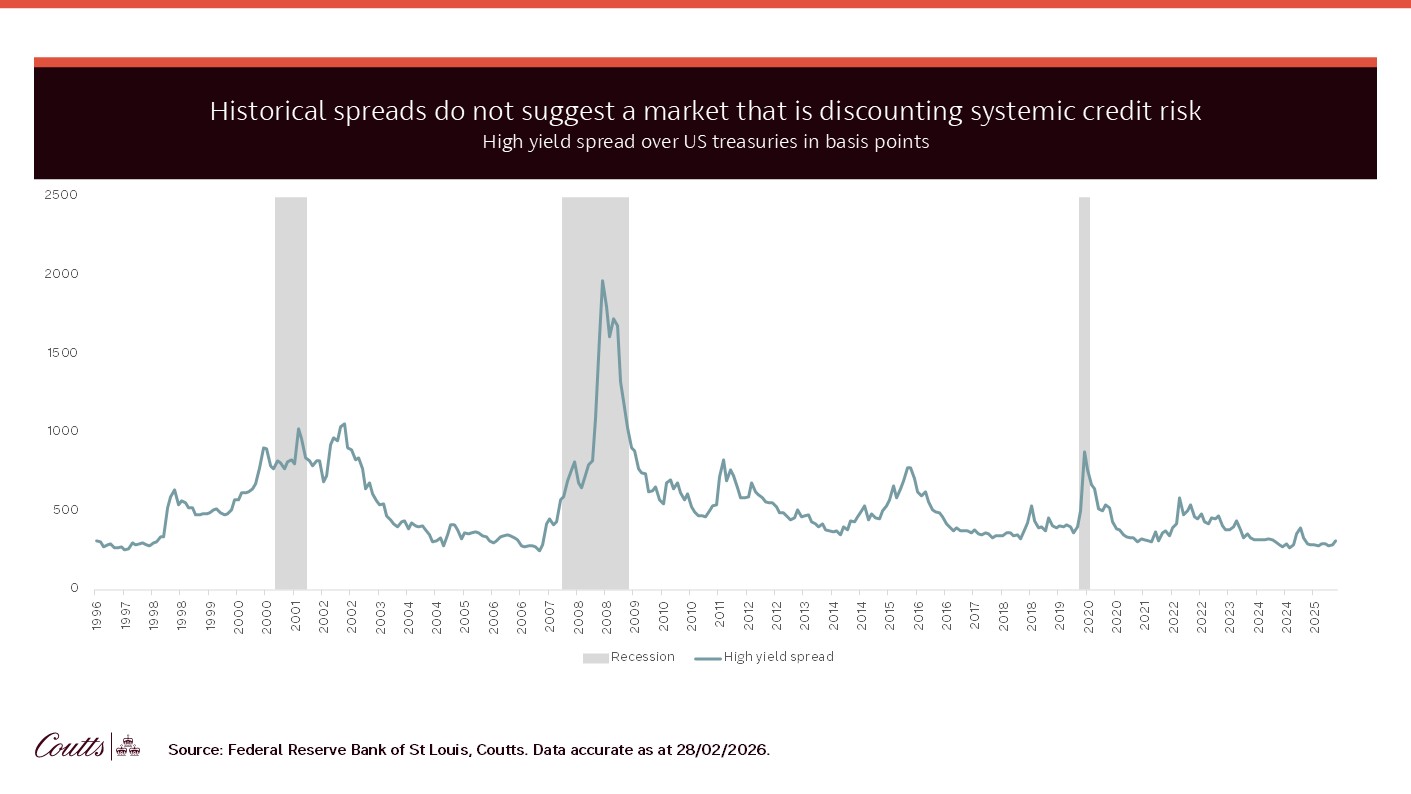
Despite investor concerns in parts of the private credit market, there is limited evidence of a broader systemic credit event. Public high-yield credit markets are more liquid than private credit and are typically more sensitive to risk sentiment. So far, high-yield credit is not showing signs of strain.

Across key fundamentals - profitability, leverage, and cash generation - US high yield remains resilient. Corporate earnings before interest, taxes, depreciation, and amortisation (EBITDA) margins are approximately 22%, indicating that US high-yield issuers are profitable. US high-yield issuers are also not overleveraged. The ratio of debt to EBITDA is approximately 4.4x. While this is above post-pandemic lows, it is below the 5.3x reached in 2020.

Default rates remain below long-run averages and refinancing is still available, albeit at a higher cost. Taken together, this does not point to broad-based credit stress, but rather to a market where the relative performance of issuers is likely to become more differentiated. Credit spread levels, measuring the premium investors demand above risk-free rates, reinforce the message. At roughly 320 basis points over the US treasury yield curve, they remain far below crisis levels, suggesting that investors are not expecting a deep or disorderly default cycle.

The value of investments, and the income from them, can fall as well as rise and you may not get back what you put in. Past performance should not be taken as a guide to future performance. You should continue to hold cash for your short-term needs. This email should not be taken as advice.

Banks as a transmission channel

The banking channel is a potential route through which private credit stress could become more systemically significant. However, current lending, capital, and delinquency data do not indicate transmission at scale. The exposure of banks to the private credit ecosystem - via fund finance and lending to non-depository financial institutions (NDFIs) - has risen from about 4.9% of bank loans in 2015 to about 11.2% in the third quarter of 2025.

However, banking stress test results suggest the banking system could absorb a sizable shock. The 2025 stress test by the US Federal Reserve (Fed) included an adverse NDFI scenario and concluded that the shock would be manageable given current capital buffers. Relative to the global financial crisis of 2008, banks are better capitalised, funding is more resilient, and private credit vehicles operate with far less leverage than pre-crisis broker-dealers.

Other banking indicators tell a similar story. US Commercial and Industrial (C&I) lending standards are tighter than the unusually loose conditions of 2021, but they are not close to the levels associated with crisis periods. Delinquency rates have normalised to around 3%, close to pre-pandemic levels. This is consistent with a consolidation phase and does not signal a credit contraction that would materially impair economic growth.

What happens next?

In our view, the macro implications of outsized private credit fund redemptions should remain limited. Private credit has grown in importance but operates within a broader ecosystem that includes banks, syndicated loans, and public bond markets. Credit conditions in 2026 will be shaped by how these channels interact - not by private credit alone - and will also be impacted by positive economic growth and healthy consumer spending.

Our balanced outlook on credit markets could be challenged if we see labour market deterioration alongside materially tighter bank lending standards and a prolonged period of tighter public refinancing conditions. This could turn a contained private credit adjustment into a larger concern for economic growth and financial markets. But for now, available data do not indicate this.

Resilient fundamentals, less compelling valuations

From a house view perspective, we remain neutral on public market high-yield credit. Our view reflects valuation rather than concerns about systemic instability. Credit spreads remain tight, and the ‘Anchor’ (long-term) element of our investment process suggests we would not be sufficiently compensated for adding credit risk today.

scroll to top