Investing

AI: A global tale of creative destruction

In the latest monthly letter from our Chief Investment Officer, Fahad Kamal explores the story of AI and productivity, and highlights our latest investment views and positioning.

In my April letter, I cover:

Artificial intelligence is now a part of the real economic landscape

AI spending by businesses has become a visible, measurable driver of economic activity, but its longer-term impact is challenging to predict.

Risks and rethinks as employment markets adapt

Technological change can create fresh demand for workers, as well as a boost for economic growth, but timing mismatches present a key risk.

Recapping our core investment views

We maintain our preference for equities over bonds, with an emphasis on emerging markets, and continue to favour assets that can provide diversification.

The value of investments, and the income from them, can fall as well as rise and you may not get back what you put in. Past performance should not be taken as a guide to future performance. You should continue to hold cash for your short-term needs. This article should not be taken as advice.

Although events in the Middle East are currently shaping daily market moves and impacting the news headlines, as investors we take a longer-term perspective.

Inspired by the British entrepreneur and mathematician, Clive Humby OBE, who famously declared “data is the new oil”, I’m taking the opportunity to explore the story of AI.

This story has already been rewritten many times.

Earlier this year, investors were preoccupied by investment in AI infrastructure, and whether this would pay off. In equity markets, this manifested as volatility in the share prices of so-called ‘hyperscalers’.

But markets move very quickly, and in recent weeks, the narrative has shifted. Today, investors are wondering if AI will wipe out existing business models for software companies, and – by extension – if it will take away jobs. Software companies are at the centre of today’s storm as, in theory, AI agents can directly interact with databases and take over tasks like updating legacy code, analysing data, and managing workflows.

However, if AI is to cause fundamental disruption to sectors such as software – and more widely how data and knowledge is created and deployed in enterprises – then the economic consequences of AI are truly likely to be profound.

In terms of this debate, we are less interested in speculation on individual companies or sectors. Our focus is on the big picture: what we believe is a meaningful, systemic surge in productivity, which will have vast benefit across the economic landscape.

Existential speculation is all well and good, but it’s our job to analyse the landscape, focus on the data, and make investment decisions that focus on the long term in line with our time-tested investment process. That starts with considering how AI capex is shaping economic growth, productivity, labour markets – and ultimately, investment opportunities.


Reading between the lines: AI and economic growth

Almost exactly a year ago, on 2 April 2025, President Trump’s ‘Liberation Day’ tariff announcement led to significant market volatility. Among the knock-on effects, the news created uncertainty about everything from consumer prices to American ‘exceptionalism’ to the international ‘rules-based’ order.

In this environment, AI capex helped to stabilise a stuttering US economy. As consumption weakened following Liberation Day, spending on IT equipment and software – a reasonable proxy for AI investment – added resilience to the economy. Despite uncertainty over long-term productivity payoffs, AI capex is already delivering economic returns today.

This year, major hyperscalers are forecast to spend $600bn of capex – around 30% more than expected at the start of the year. It’s worth noting that capex at these levels means more than a one-off ‘shot in the arm’ for the economy. When new data centres are built, they equate to multi‑year projects, bringing increased demand for skilled labour, materials, and broad construction activity. In this way, the economic and market impact of AI capex can broaden beyond AI-related sectors. 

Long-term change can arrive in disguise

Hindsight is a wonderful thing, but the reality is that structural (fundamental, long-term) productivity shifts often feel cyclical (temporary reactions to economic conditions) when they first appear.

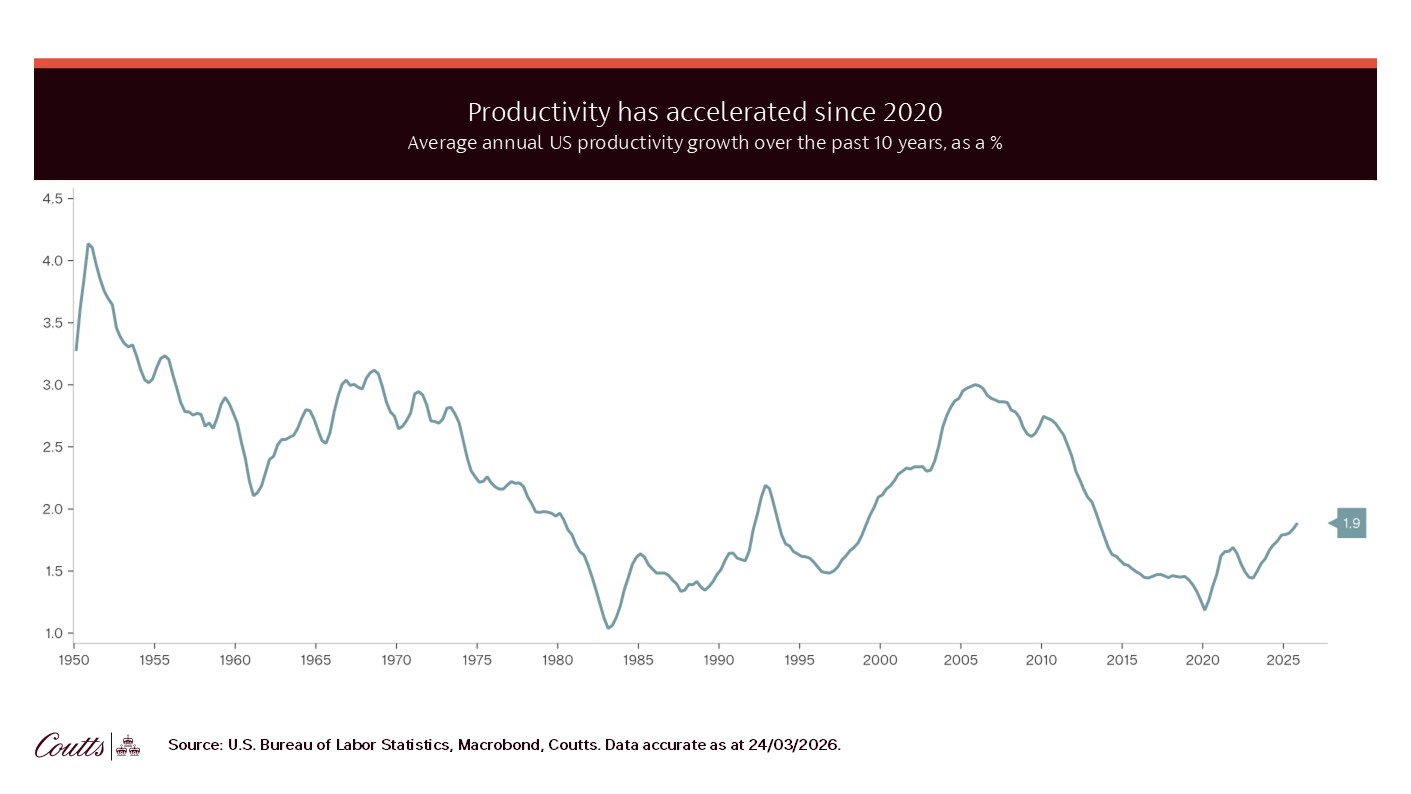
The productivity acceleration we’ve witnessed since 2020 is a good example. At first, this increase in productivity felt – to investors and financial markets – like a period of cyclical economic strength. Our proprietary growth indicators have been more positive about economic growth than market consensus in recent years, but it is only with the benefit of hindsight that we have been able to attribute that economic strength to productivity growth. 

The next chapter for productivity

It’s our view that AI will support long‑term productivity growth. But the timing, magnitude, and distribution of this growth are up for debate, not least because forecasting productivity is inherently difficult.

This challenge is amplified by the pace of ongoing improvements in AI model performance, and the rapid expansion of potential uses for this evolving technology. According to METR – Model Evaluation and Threat Research, a nonprofit that measures the capabilities and risks of AI systems – AI model capability is doubling roughly every seven months.

Little surprise, then, that no two academics can agree on the potential productivity impact of AI. Estimates suggest that AI could increase ‘total factor productivity’ by anything from 0.07 to 0.5 percentage points annually. These differences may appear small, but even seemingly minor productivity increases have vast implications when compounded over multiple years.

Our team recently evaluated five peer-reviewed papers forecasting the productivity growth of AI, written by industry experts at leading institutions. Based on the productivity growth estimates across these five papers, our research indicates this could translate into approximately $5 trillion of equity market value over the next 10 years, albeit the potential range around this $5 trillion figure is wide.

Rewriting employment markets through technological change

We know that history doesn’t repeat itself, but it is often said to rhyme. The history of technological change tells a convincing tale of humans continually shifting to more productive uses of their time and labour.

In the early 1940s, the economist Joseph Schumpeter coined the term ‘creative destruction’. He used the term to describe how innovation makes older technology and business models obsolete, but simultaneously creates new, more efficient models, and drives long-term economic growth in the process. This is an important feature of technological change. While transition can be unnerving – whether this is charted through blacksmiths being displaced by automobiles in the early 20th century, or by volatile software share prices so far in 2026 – it can also lead to new growth.

At this point in history, we are about 150 years into a wave of technological disruption related to automation. AI is the latest example, and a powerful one. But it’s important to note that a century and a half of automation has not created a structural increase in unemployment. Every phase of technological development has made some jobs obsolete, but has offset this by creating more jobs too.

As the chart below shows, changes in labour markets due to technology and automation are not new. Manufacturing has become an increasingly small part of the US labour force over the last few decades – in part due to offshoring, but also due to the automation of manufacturing processes in the US. Similarly, ‘Trade, Transportation and Utilities’ – which also includes the retail sector – has become a smaller percentage of the workforce. This change has not led to one quarter of the US workforce becoming perpetually unemployed; instead, a parade of new industries and subsectors have emerged over time, creating fresh demand for workers and a boost for economic growth.

In our view, the core risk AI presents to the economy via employment is a timing mismatch: current jobs becoming obsolete faster than new ones are created. However, we do not currently see signs of this, though we’re closely monitoring a spectrum of economic signals such as weekly unemployment claims, which remain remarkably stable.

A twist in the tale: the US is not the only tech hub

In our view, despite share price volatility, the AI narrative remains one of enhanced productivity, and therefore should continue to be a key driver for global equity market performance.

As the world’s largest economy, we naturally think about the US in this context, but AI is a global story. We have plenty of exposure to the US tech sector, but we continue to believe that emerging markets (EM) remain the most attractive place to gain exposure to AI-driven corporate earnings.

Proportionally, the level of technology exposure in EM equity markets is nearly as high as in the US equity market, and much higher than in non-US developed equity markets including Europe. Around a third of the EM equity universe falls within technology, or technology-adjacent, sectors.

Asian economies in particular occupy crucial positions in global technology supply chains, and stand to gain as demand for AI continues to grow. Not only is AI capex serving as an important tailwind for economic growth among Asian technology giants, but businesses like semiconductor manufacturers in this region can offer exposure to the AI theme at significantly lower valuations than their US counterparts. 

Our core views on key asset types

Events in the Middle East have shaped daily market moves and dominated news headlines since early March. Financial markets are always forward-looking, which can create volatility when investors attempt to account for fast-moving events in the price of financial assets.

However, we take a longer-term perspective on investing. Our portfolios are designed to weather a range of situations, with diversification across asset classes, regions, and sectors intended to provide resilience when any single shock dominates the headlines.

Our Anchor and Cycle investment process aims to harvest attractive risk premia while leaning into favourable economic growth and earnings fundamentals. We do not make knee-jerk responses to events, however significant they may appear in the popular press in real-time. 

Below, we recap some of our highest conviction investment views.

Bonds are not offering enough, we prefer equities

UK and Eurozone interest rate hikes are now expected in 2026, but we are cautious about reading too much into expectations, especially as central banks wait to assess any inflationary impact stemming from recent events in the Middle East. We had been circumspect on the prospects for bonds prior to the current conflict, given a lack of diversification benefits versus equities as well as structurally higher inflation.

Despite the current volatile market environment, the global economy entered this situation from a position of strength. Our proprietary analysis continues to indicate that the economy is in an ‘expansion’ phase, which traditionally supports stronger equity returns over bonds. We therefore maintain our view that equities will outperform bonds.

Diversification through gold and ‘liquid alternatives’

Aiming to bolster diversification within investment portfolios, we have – in certain portfolios – enhanced our allocation to alternative assets through gold and liquid alternatives.

We have a modest overweight allocation to gold, which has been supported by central bank purchases and a broad investor base, though it has not consistently served its traditional safe haven role amid recent Middle East events. We maintain our overweight gold view, but also emphasise our view that multi‑asset portfolios should be constructed for a range of scenarios, reflected through a diversified basket of assets.

Liquid alternatives, meanwhile, have strongly outperformed equities and bonds. These assets include flexible strategies to limit losses, although they are appropriate only for certain investors.

Emerging markets

Earlier this year, for the first time in a number of years, our regional analysis revealed growing opportunities in EM equity markets. Equity prices in these regions tend to perform well during periods of economic expansion and recovery. Consistent with our view that the global business cycle is heading towards expansion, EM economies could be set to benefit.

EM equities are also supported by robust technology sectors in countries such as South Korea and Taiwan. As we noted above, EM valuations remain attractive relative to the US, with promising earnings growth, particularly in semiconductor exports linked to AI developments.

In a nutshell: We favour equities over bonds and enhanced diversification through gold and liquid alternatives. We hold an overweight position in emerging market equities to capture growth potential in 2026.

The long‑term impact of AI on economic growth and equity markets remains impossible to predict with precision. For now, AI capex is clearly providing a powerful tailwind for economic growth via the buildout of data centres and other infrastructure.

In future, we expect AI to lead to structurally higher growth through enhanced productivity. In doing so, it may begin to address the deep-rooted challenges of our age, from indebtedness and inequality to instability.

While we cannot predict every chapter of the AI story, we can observe and analyse the data and trust in our robust investment frameworks.

Yours sincerely,


Fahad Kamal

Chief Investment Officer

scroll to top