By Joe Aylott, Multi-Asset Strategist

If anyone was holding out hope for calmer geopolitics in 2026, the first two weeks of 2026 will have delivered an awakening. The removal of the Venezuelan president, the seizure of a Russian-flagged tanker, and anti-government protests in Iran have set the scene for a dramatic January.

Despite this, equity markets have remained steady. This does not surprise us. 

Geopolitical upheaval can come at a very heavy price for the individuals and populations involved. However, in modern history geopolitical flashpoints have rarely had a lasting impact on financial markets. 

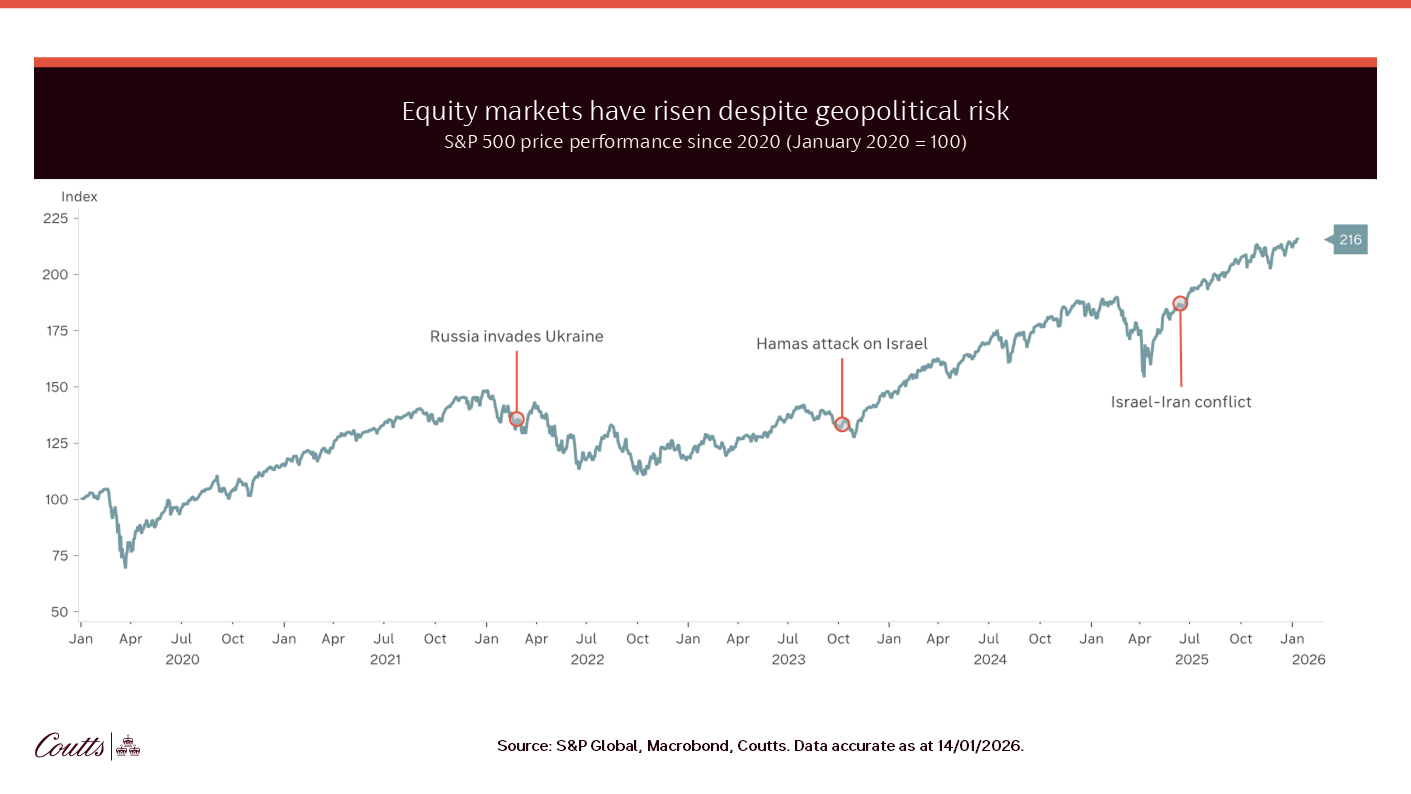
The last five years have demonstrated this well. Despite a geopolitical backdrop that has become increasingly more complex, equity markets have risen over the most recent one-, three- and five-year periods (see chart). 

Past performance should not be taken as an indication of future performance. You should continue to hold cash for your short-term needs.

As the second chart below shows, volatility when geopolitical flashpoints occur is normal, as investors re-assess their tolerance for risk and adjust to events. Equity market declines of 9-10% are quite common in these periods, but markets have tended to move on very quickly.

When geopolitics do impact markets, the most common reason is oil prices. Based on our analysis, the current protests in Iran, and the operation to remove President Nicolás Maduro from Venezuela, are unlikely to significantly alter global oil markets. Venezuela is a relatively small producer from a global perspective, and output in Iran has been limited by extensive sanctions.

Finally, there is currently ample supply of oil globally. This leads us to believe that the geopolitics will have limited impact on global oil prices or inflation.

A new world order brings new risks

For equity markets to perform well, the most important factor is reliable economic growth and its translation into growing company earnings. While economic growth is driven by demographics and productivity, the reliability of earnings centres on institutional depth (such as the rule of law, reliable enforcement of contracts, stable policymaking, and corporate governance). 

Although the US may have partially stepped back from its 20th century role as the world’s policeman, it’s still setting geopolitical trends. US President Donald Trump has altered the rules-based international order, and in place of historic norms, the US, China, and Russia have honed their individual spheres of influence. 

This is an uneasy dynamic, and over the long run could have implications for other contested territories.

For example, there are rising concerns that China – witnessing the actions of the US and Russia – could seek to exert further influence on Taiwan. For erstwhile resilient markets, this could be a bitter pill to swallow. Taiwan’s semiconductor expertise is critical to the global technology industry, with the potential to disrupt earnings in the technology sector if challenged.

But while this particular issue represents a meaningful threat to equity markets, it’s also a threat which has existed for many years. We could have written these same sentences about Taiwan during Trump’s first term in office, and markets have risen much higher since then. While this doesn’t make the threat a comfortable one, it does highlight that reacting too early to a potential geopolitical flashpoint can lead to missing out on investment returns.

Markets are growing used to geopolitical turbulence

The full geopolitical ramifications of events in the opening weeks of this year, and indeed over the past 12 months, remain to be seen. But the geopolitical picture has grown in complexity, and this trend looks set to continue.

We know that markets are becoming increasingly accustomed to navigating such a complex geopolitical backdrop alongside a resilient economic outlook. And as we begin 2026, we’re seeing signals that the global economy could be reaccelerating. This would be positive for equity markets, as it reduces the likelihood of a recession emerging later this year.

From our vantage point, the lesson from recent years appears to be that stepping away from investment markets is unlikely to be the correct response to a geopolitical crisis. Instead, staying invested for the long term, in well-diversified portfolios, could be the most effective way to navigate near-term uncertainty and compound long-term financial returns.

scroll to top